THE YELLOW WASH JOURNAL · BUSINESS GUIDE
Can Your Storefront Be Cleaned Without Closing the Business?
A practical guide to cleaning around customers, deliveries and opening hours in Halifax and HRM.

Sometimes—if customers and staff can remain separate from the active cleaning area. Daytime storefront cleaning depends on the entrance layout, the surfaces being washed and the ability to control spray, water and equipment. If the only usable entrance or access route must be cleaned, arrange a separate work window before opening, after closing or during a planned pause.
For a Halifax shop, Dartmouth restaurant or Bedford office, the aim is a clean frontage with a workable access plan. “We will work around you” should mean an agreed sequence, a clear customer route and a named contact—not repeated last-second stops as people step through the work area.
Before opening or during business hours?
Choose the work window after looking at the site. The same business may use daytime glass cleaning for one visit and an out-of-hours entrance wash for another.
On a phone, swipe the table to compare both options.
| Planning point | Before opening / after closing | Staged daytime cleaning |
|---|---|---|
| Best fit | The doorway, entrance paving or most of the frontage needs washing. | A defined section can be isolated while a suitable customer route stays available. |
| Main advantage | Fewer conflicts with customers, queues and deliveries. | Some work can proceed while the business operates elsewhere on the premises. |
| What to arrange | Staff access, keys or alarm arrangements, lighting and a reopening check. | Barriers, signs, staff communication and separation of people from water and equipment. |
| Main limitation | Finishing the wash does not automatically mean the area is ready for opening. | A quiet moment is not enough if the only entrance crosses the work zone. |
| Backup plan | Allow time for cleanup and reassess if weather changes the conditions. | Stop or move the work window if the agreed route cannot be maintained. |
Start with the doorway, then plan the rest
Walk the route a customer actually uses—from the sidewalk or parking area to the door. Include people using wheelchairs, walkers or strollers, and leave space for the door to operate normally. A second door is useful only if the building approves its use and it provides a suitable route; an unfamiliar service entrance is not automatically a customer entrance.
Keep required emergency routes available throughout the work. CCOHS emergency-planning guidance calls for evacuation routes to be identified, communicated and kept unobstructed. [2] Coordinate with the building manager before changing normal access arrangements.
Four parts of a workable plan
- Separate the work zone. Include the area affected by spray and runoff, not just the glass or wall being washed.
- Keep the customer route clear. Protect the usable approach to the entrance and preserve emergency access.
- Keep equipment inside the work area. Plan hose and cable routes so people do not need to step over them.
- Clean the entrance separately. Schedule the threshold and its approach for a window when that route is not needed, with any required alternative access agreed.
Match the sequence to the surfaces
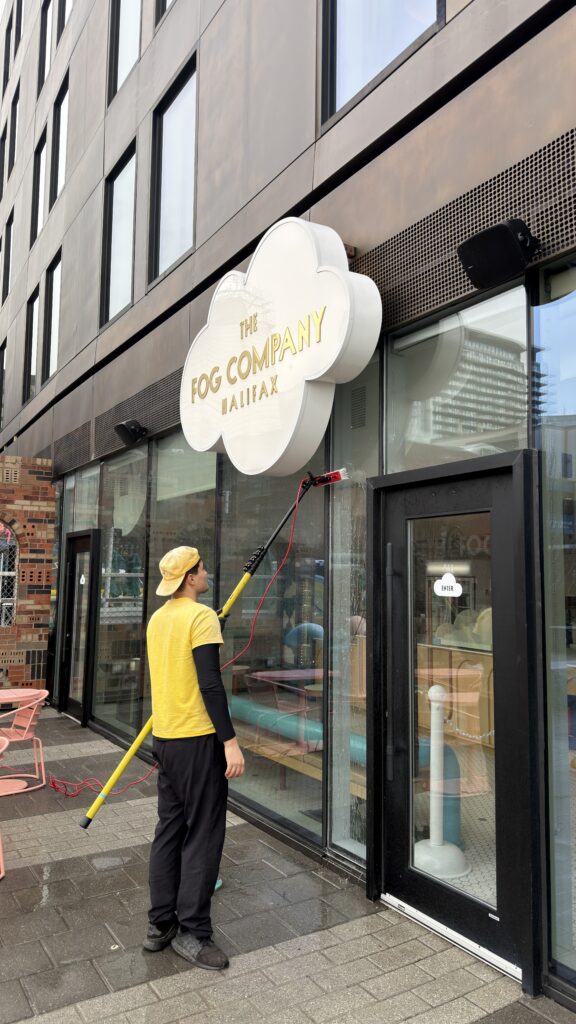
Yellow Wash’s storefront cleaning service covers agreed glass, doors, frames, signage areas, awnings, entryways and nearby exterior surfaces. Methods include purified-water glass cleaning, soft washing on suitable finishes, pressure washing of suitable durable entrance surfaces and hand detailing.
- Glass and frames: agree which window section is isolated first and where the pole, hose and rinse water will be. Door glass needs its own access arrangement.
- Awnings and signage areas: review material condition and the area below. Move or protect displays, patio furniture and other belongings as agreed before cleaning starts.
- Entrance paving: plan washing and cleanup around the doorway and customer approach. Do not funnel customers through a wet work zone just to keep the door open.
Where upper surfaces and the paving below are both included, agree a sequence that avoids dirtying a finished area again. Specialist stain removal is included only when specified in the work scope. For larger glazing areas, see our commercial window-cleaning service.
Agree these details before the crew arrives
- Trading and delivery times: share opening hours, busy periods, pickup queues and scheduled deliveries. Identify a realistic work window rather than simply requesting “early.”
- Building coordination: confirm permission for shared frontage, water access, equipment placement and any changes affecting neighbouring tenants. For work affecting a public sidewalk or right-of-way, check the proposed arrangement with HRM before booking; the municipality lists relevant permit routes on its Streets and Services Permits page.
- People and belongings: name the staff contact who can explain the temporary route, relocate agreed items and alert the crew if a delivery or queue changes the plan.
- Water and weather: confirm runoff handling and protection of adjacent spaces. For a fall visit in HRM, review the forecast, lighting and conditions underfoot; reschedule wet work if freezing or other conditions make the plan unsuitable.
Reopen the area after a check—not just when spraying stops
CCOHS identifies wet walking surfaces, clutter and uncovered cables as slip or trip hazards. Its guidance includes marking wet areas, clearing walkways and dealing with spills. [1] A warning sign should accompany the work-area controls; it is not a reason to direct customers through the active wash.
Before removing barriers, have the agreed staff contact and cleaning lead review the route: equipment and hoses removed, loose debris and pooled wash water addressed, door operation unobstructed and the walking surface suitable for use. Keep any unfinished section isolated. Set reopening around the actual conditions, not a fixed drying-time promise.
Plan a storefront clean around your business
Send Yellow Wash your Halifax or HRM address, frontage photos, opening hours, delivery times and the surfaces you want cleaned. Include the entrance and sidewalk in the photos. We will review whether staged daytime work or a separate cleaning window suits the property.